

Robotic Process Automation (RPA) has been hailed as a game-changer for businesses looking to automate manual tasks and improve efficiency. Although the robotic process automation market is expected to grow from 2024 to 2030, some organizations are still hesitant to switch from manual to automated processes due to uncertainties about their existing business processes. This is where process mining comes in.
Process mining is a powerful tool that can help businesses gain clarity on their processes and identify areas for improvement. By combining the capabilities of process mining and RPA, organizations can revolutionize their approach to automation and drive significant efficiency improvements.
How Does Process Mining Work?
Process mining is a data-driven approach to process analysis that aims to improve processes based on empirical data. It involves three main steps: data preparation, process discovery, and conformance checking.
1. Process Discovery
During data preparation, event logs are collected from various sources, such as IT systems and applications. These logs contain information about the execution of activities within a process, such as timestamps, user IDs, and activity names. It creates a visual representation of the existing process flow.
2. Conformance Checking
Conformance checking is performed to ensure that the observed process behavior complies with the prescribed process model. This allows organizations to identify bottlenecks, inefficiencies, and deviations from the intended process flow.
3. Enhancement
Finally, the additional information obtained from conformance analysis aids in pinpointing possible enhancements for the current processes.
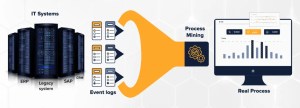
Process mining offers several key benefits, including:
- Identifying bottlenecks and inefficiencies in processes, allowing for targeted process improvements.
- Improving process transparency by providing a clear, visual representation of process flows.
- Enhancing compliance by identifying deviations from the prescribed process model and ensuring adherence to regulations and standards.
Combining RPA and process mining to maximize benefits
Process mining and Robotic Process Automation (RPA) are vital components of intelligent automation, offering deep insights and streamlined operations. Process mining is an invaluable tool that uncovers inefficiencies and bottlenecks by analyzing event logs, and enabling targeted improvements. RPA tool automates repetitive tasks, enhancing productivity and accuracy. Though both are two different solutions, together, they form a powerful duo in intelligent automation, driving efficiency, and facilitating continuous process optimization.
RPA is often used in conjunction with process mining to automate repetitive, rule-based tasks within a process. RPA bots can extract data from various sources, such as databases, spreadsheets, and web applications, and perform actions based on predefined rules.
- Data Collection: RPA bots can be used to collect event logs and other data needed for process mining from different systems and applications. As process mining requires data in order to get the desired results, this automation guarantees that the data is acquired reliably and consistently.
- Data Preparation: RPA bots can help in preparing the data for process mining by cleaning, transforming, and aggregating it as required. Automation reduces the manual effort involved in data preparation and ensures data quality.
- Process Discovery: RPA bots can be used to simulate the execution of a process based on the event logs and other data. This simulation can help in identifying bottlenecks, inefficiencies, and deviations from the intended process flow.
- Conformance Checking: RPA bots can compare the observed process behavior with the prescribed process model to ensure compliance. Any deviations can be flagged for further investigation.
- Process Improvement: Based on the insights gained from process mining, RPA bots can be used to automate parts of the process to improve efficiency and reduce errors. For example, if a bottleneck is identified, RPA bots can be deployed to automate that task.
Overall, RPA complements process mining by automating tasks that are repetitive and rule-based, allowing organizations to focus on more strategic aspects of process optimization and improvement.
This synergy between RPA and process mining not only accelerates the discovery and implementation of process improvements but also supports the continuous evolution and optimization of business operations. Bautomate’s Intelligent Automation platform bridges the gap between these technologies, allowing organizations to seamlessly integrate process mining insights into their automation strategies. This synergy enables organizations to achieve higher levels of automation excellence.
If you’re considering adopting Robotic Process Automation for your business, you’ve come to the right spot. Share your challenges with us, and we’ll assess your workflows. Contact our automation experts to get started.